Shave It to Save It: How the Undercut Became the Most Empowering Cut in the Salon Chair
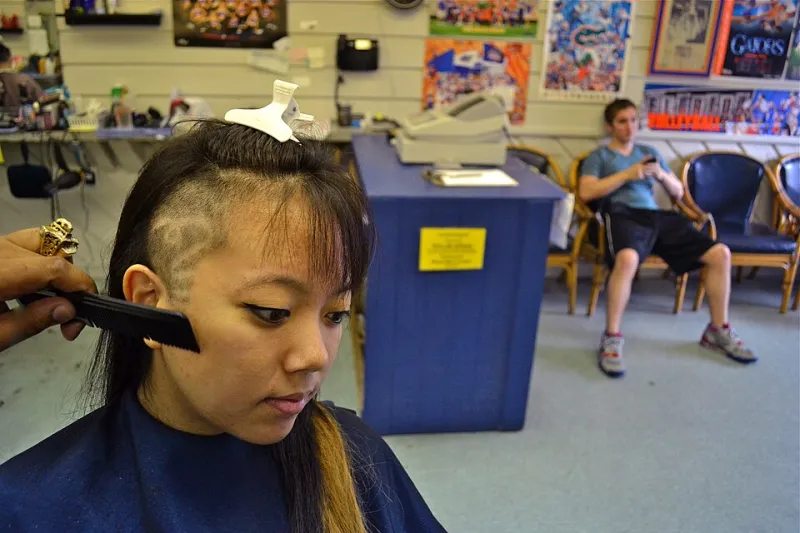
Photo: Chris Gilmore, CC BY-SA 2.0, via Wikimedia Commons
There's a moment in the salon chair that regular clients know well. You've been sitting there for a while, watching your hair transform, and then — right at the end — your stylist tilts the mirror so you can see the back. If you've just gotten an undercut for the first time, that moment hits differently. Something shifts. You sit up a little straighter. You might even laugh.
That reaction? It's not just about the hair.
The undercut has quietly become one of the most requested cuts at D. Cole Hair Design, and it's not hard to see why. In a world where beauty standards keep cycling between "natural and effortless" and "bold and maximalist," the undercut lands somewhere powerful — it's both. It's the kind of choice that says I did this for me, and that energy follows you everywhere.
What Exactly Is an Undercut, Anyway?
If you've only seen the term floating around Pinterest boards, here's the quick breakdown. An undercut refers to any style where a section of hair — usually underneath the top layers — is cut significantly shorter or shaved close to the scalp. The shorter section is often hidden when hair is worn down, but it can be revealed with an updo, a ponytail, or simply brushing the hair aside.
There are a few main variations:
- The nape undercut — a clean shave at the base of the neck, often with a defined edge or geometric line
- The side undercut — one or both sides shaved or closely cropped, sometimes paired with longer layers on top
- The hidden undercut — a shaved section tucked beneath longer hair, almost like a secret you get to reveal on your own terms
- The design undercut — a shaved area featuring etched patterns, florals, geometric shapes, or even portraits done with a razor or clipper
Each variation carries its own personality, and the right one depends on your hair type, face shape, lifestyle, and honestly — your vibe.
Finding Your Version of Bold
Not every undercut looks the same, and that's the beauty of it. For clients with thick, heavy hair, a side or nape undercut does double duty — it removes bulk and adds an unexpected edge. For those with finer hair, a hidden undercut can create the illusion of fullness on top while still delivering that satisfying "reveal" effect.
Face shape matters too. A symmetrical undercut on both sides tends to work beautifully for oval and heart-shaped faces, elongating the silhouette. A single-sided undercut can add asymmetry and visual interest to rounder face shapes. And for those with longer necks, a clean nape shave is practically made for them — it draws the eye and highlights a feature most people don't even think to show off.
At D. Cole, consultations for undercuts always start with a real conversation. What do you want people to notice? What do you want to keep hidden? How much maintenance can you realistically commit to? The answers shape everything.
The Psychology Behind the Shave
Here's the part that doesn't get talked about enough: why does an undercut feel so good?
Psychologists who study appearance and identity often point to the concept of "enclothed cognition" — the idea that what we wear (and how we style ourselves) affects how we think and behave. Hair is a massive part of that equation. When you make a deliberate, unexpected choice with your appearance, it signals something to your own brain. You made a move. You took up space. You decided.
For a lot of clients, the undercut represents a line in the sand. It might come after a breakup, a job change, a milestone birthday, or just a long stretch of playing it safe. Whatever the catalyst, the cut tends to land as a physical marker of a mental shift.
One client — a middle school teacher from outside Chicago — came in asking for a nape undercut after years of keeping her hair "school-appropriate." She'd been toying with the idea for two years. "I kept thinking, is this too much? And then I realized — too much for who?" she said. "The second I saw it, I felt like myself in a way I hadn't in a long time."
Another client, a guy in his late twenties who works in finance, asked for a design undercut — a subtle geometric pattern on the side — that only shows when he cuts his hair short for summer. "Nobody at work has to know it's there," he said. "But I know. And that's kind of the whole point."
Undercuts Across Hair Types and Textures
One thing worth calling out: undercuts are genuinely for everyone. Straight, wavy, curly, coily — every hair type brings something different to the table.
For curly and coily hair, the undercut is especially impactful. Removing weight from underneath allows the top layers to spring up and coil more freely, creating volume and shape that's hard to achieve otherwise. Many naturalistas have found that a subtle undercut actually enhances their curl pattern rather than competing with it.
For straight hair, the undercut adds dimension and contrast — the sleekness of the longer layers against a buzzed or shaved section creates a really striking visual effect.
For wavy hair, the undercut can help manage the dreaded "triangle effect" (too much volume at the bottom, not enough at the top) by strategically removing bulk where it tends to accumulate.
Maintenance: The Real Talk
Okay, let's be honest about upkeep. Undercuts do require regular maintenance — especially if you want that shaved section to stay clean and defined. Depending on your hair's growth rate, you're likely looking at touch-ups every four to six weeks. Design undercuts need even more frequent visits to keep the detail sharp.
The good news? The in-between stage isn't a disaster. Grown-out undercuts have their own relaxed charm, and many clients actually love the soft, slightly-grown look before their next appointment. It's a cut that evolves with you.
Is It Your Time?
If you've been circling this idea for a while — saving photos, watching videos, wondering — that probably means something. The undercut isn't for everyone, but it's for more people than think it is. It's not about rebellion for rebellion's sake. It's about making a choice that's entirely yours.
At D. Cole Hair Design, we believe every strand tells your story. The undercut is just one of the boldest chapters you can write. If you're ready to start that conversation, we're here for it.